
Guide to collect rocks, minerals and fossils - Rules and Regulations
• Bureau of Land Management
• US National Forest
• Rivers and Creeks
• Oregon Coast
• Oregon State Parks
• US Army Corps of Engineers
• County Parks
The ability to collect rocks, minerals, and fossils on public lands without a permit depends on several factors, including a location, the managing agency, the type of minerals or fossils, and the quantity gathered.
It is essential to follow all rules and regulations for rock collecting specific to each area you visit.
Most rock and mineral collecting sites are on federal lands managed by the Bureau of Land Management (BLM) or the U.S. Forest Service.
According to both agencies, collecting rocks and minerals for personal, non-commercial use typically does not require permits. Only hand tools, including geological picks, shovels, and jackhammers, are allowed.
Bureau of Land Management Rockhounding Regulations
The Bureau of Land Management (BLM) defines rockhounding as collecting reasonable amounts of mineral specimens, rocks, semi-precious gems, petrified wood, and invertebrate fossils.
Invertebrate fossils refer to the remains of creatures without bones, such as corals and shellfish, as well as common plant fossils.
Generally, public lands are open to rockhounding, except in areas like National Monuments. Always verify whether the land where you plan to collect rocks, minerals, or fossils is managed by the BLM, as jurisdictional boundaries may not be clearly marked.
In Oregon and Washington, BLM regulations allow a no-fee daily limit for personal-use collection of 25 pounds plus one piece. The yearly limit is 250 pounds, which includes minerals, semi-precious gemstones, common invertebrate fossils, petrified wood, and other rocks.
Only hand tools, such as shovels, picks, and hammers, are allowed for collection. Metal detectors may also be used. However, using motorized or mechanized equipment, heavy machinery, and explosives is strictly prohibited.
Groups of individuals cannot combine their yearly allowances to collect a single item that exceeds 250 pounds. For pieces larger than this limit, you must contact your local BLM office for approval.
Rockhounding is prohibited at developed recreational sites unless explicitly designated as rockhounding areas.
In Wilderness Areas, rockhounding is limited to surface collection only. It is also essential to respect laws that protect cultural and historical artifacts. Items such as Native American artifacts (e.g., arrowheads, pottery fragments, or burial remains) and vertebrate fossils (e.g., fish, mammals, or dinosaurs) cannot be collected.
Before visiting a site, check with the BLM for up-to-date regulations, specific locations, and any potential mining claims to ensure compliance.
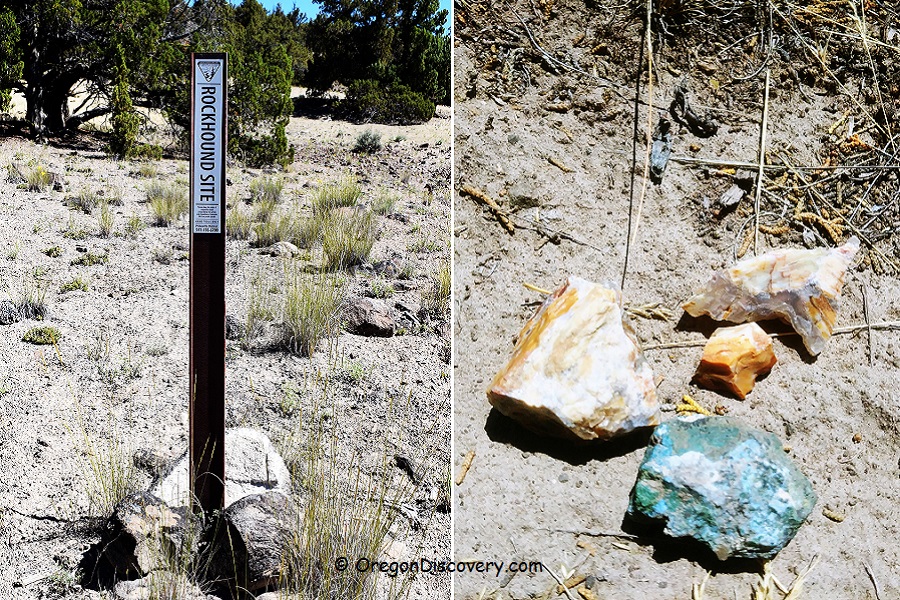
U.S. National Forest Rock Rockhounding
The U.S. Forest Service permits recreational rockhounding on most National Forest lands.
The U.S. Forest Service limits specimen collection to 10 pounds. Some National Forest lands are closed to collecting due to wilderness designation. Contact the U.S. Forest Service for up-to-date information on specific areas.
Vertebrate fossils, such as animal, dinosaur, and fish bones, cannot be collected. Archaeological items, such as pottery fragments, arrowheads, and other artifacts, are also prohibited from being collected.
Wilderness Areas Rockhounding
Rockhounding on federally managed lands is a popular hobby, but the rules for land designated as a Wilderness Area are often stricter and may differ significantly from general federal land rules.
Knowing which agency manages the land — and whether it is a designated Wilderness Area — is important for protecting nature and avoiding fines.
BLM
Generally, BLM-managed wilderness areas allow hand collection of surface materials without motorized tools for personal, non-commercial use.
You should not disturb the ground. Some places may have extra restrictions. It is best to contact the local BLM office before visiting.
U.S. Forest Service
Wilderness areas within National Forests often have stricter rules. Some forests allow limited surface rock collecting, but many prohibit it to protect natural conditions and sensitive habitats.
Rules can vary between forests and even between different wilderness areas in the same forest.
Always check with the local ranger district before collecting.
National Park Service (NPS)
The National Park Service manages wilderness areas within national parks. In most cases, collecting rocks, minerals, or fossils is not allowed. These areas focus on preserving natural and cultural resources, and the removal of natural materials is prohibited.
U.S. Fish and Wildlife Service (USFWS)
The U.S. Fish and Wildlife Service manages wilderness areas inside wildlife refuges. These areas have strict protection rules, and collecting rocks or minerals is usually prohibited to protect wildlife and habitat.
U.S. Army Corps of Engineers Rock Collecting Regulations
Rock collecting is prohibited within U.S. Army Corps of Engineers property boundaries, encompassing all reservoirs.
According to Section 327.14 of Rules and Regulations Governing Public Use of U.S. Army Corps of Engineers Land, "Removal or any alteration of natural formations, mineral deposits, historical and archaeological features, paleontological resources is prohibited except when in accordance with written permission of the District Commander."
Rivers and Creeks Rockhounding Regulations
Access to rivers and creeks for rockhounding depends on who owns or manages the land. Public access may be on federal, state, or county land, and each has different rules for collecting.
The riverbed and banks are considered part of the managed land, so rocks and other materials in or along the river are protected under that land’s rules.
If collecting is allowed, take only surface materials. Digging, dredging, or using motorized tools in the riverbed is usually prohibited. On federal lands, small amounts for personal use are generally allowed, but Wild and Scenic Rivers are strictly protected, and removing rocks from them is not allowed.
However, some areas have stricter rules; for instance, in county parks, removing rocks or digging in the riverbed is considered damaging park property and is prohibited.
If a stream is designated as Essential Salmonid Habitat, you may remove small amounts of material by hand — up to one cubic yard at a single spot and up to five cubic yards total per stream segment per year — without a state removal‑fill permit.
If the waterway is a State Scenic Waterway, a scenic waterway removal-fill permit is required to collect materials.
Oregon Coast Rockhounding Regulations
A particular part of the beach might be part of the Oregon State Park. In this case, follow the regulations For Oregon State Parks. However, there are some general rules for collecting materials on the Oregon Coast beaches.
You can remove no more than one gallon of agates and other non-living items such as shells, stones, and fossils per person per day, up to three gallons per person per calendar year.
Rule 736-021-0090, Cultural, Historic, Natural and Wildlife Resources
Oregon State Parks Rockhounding Regulations
In Oregon State Parks, visitors are generally prohibited from digging up or removing rocks, sand, soil, fossils, or other natural materials without written permission from a park official.
However, the rules allow the collection of small quantities of rocks, agates, driftwood, or similar non-living items for personal, non-commercial use — but only in areas where the park has not specifically posted restrictions on removal by location, time of year, or signage.
County Parks Rockhounding Regulations
Generally, County Parks in Oregon prohibit rockhounding.
Here is one example of Marion County's regulations. According to a program coordinator of the county parks, mineral collecting falls under the provision 12.05.220 "Damaging park property which states D. Cut or remove any sand, wood, turf, grass, gravel, stone or timber in or from any park, or make any excavation by any tool, equipment, blasting or by any other means in any park".
Contact offices of the County Parks for up-to-date information.
Miscellaneous
Abandoned mines are extremely dangerous and must be avoided. Open shafts, deteriorated support structures, rotten timber, lack of oxygen, and various poisonous gases can result in injury or death.
Collecting material remains of prehistoric or historic human life or activities, such as arrowheads or pottery pieces, is prohibited. Vertebrate fossils (e.g., dinosaur bones, fish, and other animals with backbones) and shark teeth may not be collected.
You May Also Like






Disclaimer
Every jurisdiction can adjust its regulations for rock, mineral, and fossil collection without notice. Treat the information listed above as general rules, and always check the regulations for changes.
thanks sum time this year i will go mining for geodes
What do the colors on the rockhounding map stand for.
Hello, I am wanting to start a small business selling necklaces that I make using small rocks and agates I find on the beach and I am wondering what permit I would need to get in order to sell them without getting in trouble.
Thanks!