

Nationally known as a great place for rockhounds, Oregon produces a wide variety of rocks and quartz minerals. The state’s rich mineral deposits supply museums, private collections, and shops with colorful and valuable semi-precious stones and cut rock specimens.
Oregon Fossils, Rocks & Minerals
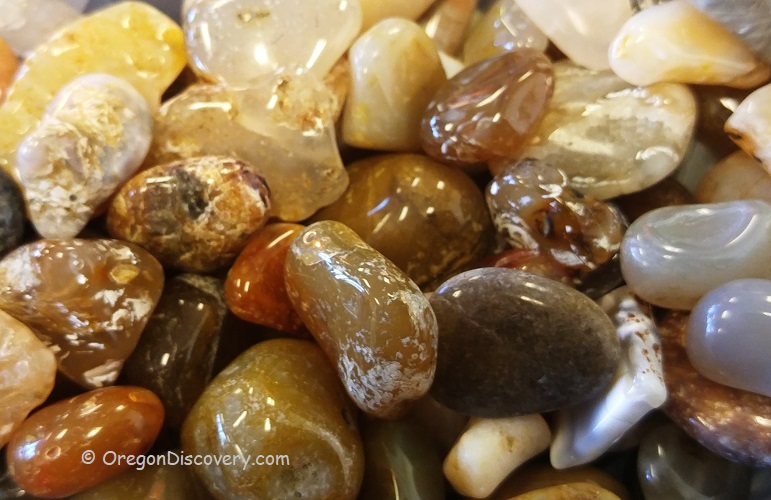
Agate is a translucent to semitransparent, fine-grained cryptocrystalline quartz composed of silicon dioxide (SiO₂). This tough and attractive mineral has excellent working properties.
Fossilized Agate - an agatized form of ancient marine life, such as clams or snails. Over time, the original material inside the shell is replaced by agate and other forms of chalcedony.
Agate Formations, Varieties, and Hunting Locations
Jasper is similar to agate and forms from chalcedony (a type of quartz). It contains iron oxides, hydroxides, and other impurities that give it its rich, varied colors.
Geode is a hollow rock that often contains mineral crystals inside. The filling is usually quartz, but it may also include opal or zeolites.
Thunderegg is a round, nodular rock formation filled with agate, jasper, opal, or other minerals.
Thundereggs - Where to Find in Oregon & How to Spot?
Limb Casts, also known as Fossil Wood, form in volcanic ash cavities that once housed wood.
The original wood either burned away or decayed, and minerals carried by groundwater later filled the cavities.
Limb casts are found in Central Oregon, including the Congleton Hollow and Dendrite Butte sites.
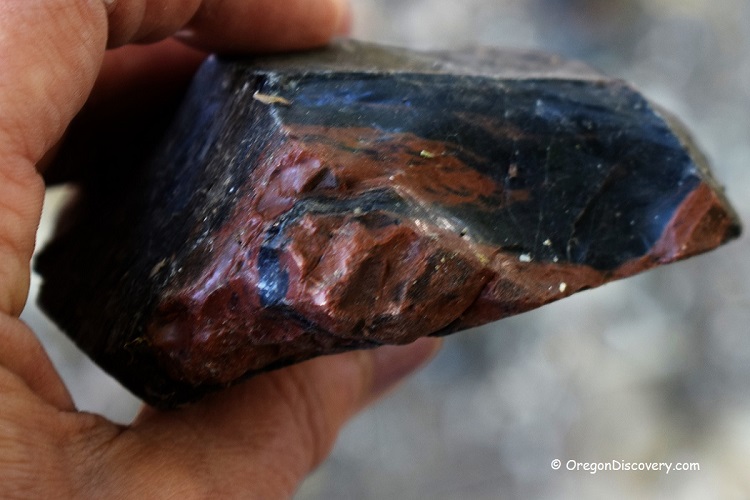
Obsidian is a volcanic glass classified as an extrusive igneous rock (not a mineral). It forms when silica-rich lava cools rapidly, preventing crystal growth and creating a glassy texture.
Obsidian is brittle and usually black, but it can also show green, purple, or bluish tones on fractured surfaces. One of the best places to find a variety of obsidian is Glass Buttes in Lake County and Mud Ridge in Harney County, southeastern Oregon.
Petrified wood, also known as Fossilized Wood, is the preserved remains of ancient trees that have turned to stone over time through mineral replacement. The word "petrified" comes from the Greek word petro, meaning "stone."
Petrified Wood: Formation, Identification, & Where to Find?
Sunstone is a transparent to translucent feldspar crystal that displays a range of colors, including clear, yellow, red, green, and occasionally blue. Specimen sizes can vary widely.

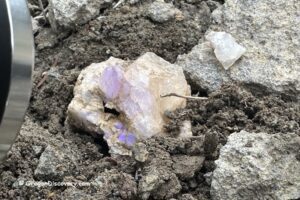
Opal is a hydrous, amorphous (non-crystalline) form of silica. Common opal is widely found in Oregon and Nevada, while precious fire opal is rare.
In Oregon, opal deposits are located at Opal Butte in Morrow County, but this site is not open to the public.
Fee-based opal collecting is available in northern Nevada at mines such as Royal Peacock Opal Mine and Kokopelli Opals.
You May Also Like




1. Arthur Thomas. "Gemstones: Properties, Identification and Use". 2008.
2. "Oregon Rocks, Fossils Minerals". Josefine County. Oregon Historical Society.
3. Nancy Marie Brown. "How Do Agates Form?". 2001. Penn State University.
4. Dr. H.C.Dake. " The Gem Minerals of Oregon". 1938. Portland, Oregon. Oregon State Department of Geology and Mineral Industries.
I am interested in collecting ores in Oregon for hobby smelting. My preference is for copper ores since the smelting process for copper is relatively easy. Secondarily, I am interested in iron ores (the information you provided concerning rhodonite was very helpful).
Thank you for the excellent article on rockhounding in Oregon!
I don’t know of any place in Oregon that has copper deposits in mine-able amounts.
The best states are Arizona, Utah, New Mexico, Nevada and Montana. There is also a little in Idaho.
There are ore deposits in the mountain areas of Cascade Mountains near Upper Lake Chelan. The Holden mine near Lucerne is closed and sealed! There was a full on iron ore, copper and gold operation in Copper Mountain inside. 56 miles of tunnels built to remove mined materials. J.R. Holden scouted and discovered in late 1880s. A Local banker in Lake Chelan loaned him money to work the mine.
The banker wanted his loan money realized!
The was sitting on a lot of money! J.R. died in 1919
leaving the banker who was not a manner owning the mine after paying the Holden family off. The banker spent years trying to sell the mining operations.
Howesound Mining Company finally purchased the operation.1930s. Howesound built a working town, the mine was called the Holden. There was a family
housing. development outside of the town called Winston, 100 homes. At one time the mining continued at an area above Copper mountain. It was called Honeymoon Heights.
Holden had a school, gym, post office, dining hall, and kitchen.
hotels, dormitories and chalets a barber shop and bowling alley, soda fountain.,hospital
The town of Holden still exists as it was. Winston was removed by the forest service because of fire danger.. There was a phone system between the mine town and housing. After the mine closed because it eventually began to loose.money!
The museum was closed recently and moved to a small area. The mine operation was. removed because of danger.
The Lutheran church eventually purchased the town of Holden for $1.00. It is now owned and responsible for maintaining the town.