• The John Day Fossil Beds is home to the world's most extensive fossil collection
• The park includes Painted Hills, Blue Basin, Sheep Rock, and Clarno Unit


Situated 40 miles west of the city of John Day, John Day Fossil Beds National Monument spans over 14,000 acres of colorful badlands, scenic canyons, and rugged volcanic landscapes.
Beyond its natural beauty, the monument preserves one of Oregon’s richest paleontological records.
John Day Fossil Beds Landscape & Natural History
The monument is named after the John Day River, which flows through the Blue Mountains and winds past the towering volcanic canyon of the Sheep Rock Unit before eventually joining the Columbia River.
In the 1860s, geologist Thomas Condon recognized the scientific importance of the fossil-rich formations found here.
Today, the monument is internationally significant for its extraordinary concentration of geological and paleontological resources.
Visitors can explore the colorful Painted Hills, the fossil-rich Blue Basin, the dramatic Clarno Palisades, and many other remarkable landscapes.

The oldest non-fossil rocks in the region date back roughly 95 million years, while fossilized plants and animals preserved within the monument are more than 30 million years old. Some fossil-bearing formations may be over 40 million years old.
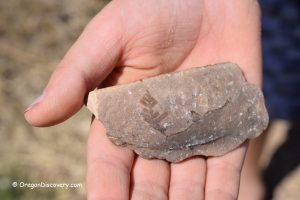
More than 60 plant species have been identified from fossils found here, including ancient relatives of palm, ginkgo, magnolia, and sycamore trees.
Scientists have also uncovered fossils of over 100 mammal species, including rhinos, oreodonts, brontotheres, early horses, and other prehistoric animals that once roamed Oregon.
When visiting John Day Fossil Beds National Monument, stay on designated trails and never remove fossils or rocks from the park.
Amazon Jungle in Oregon
Fossil discoveries show that parts of Oregon once supported lush subtropical forests somewhat similar to modern rainforests.
Over millions of years, repeated volcanic eruptions buried forests beneath layers of ash and sediment, helping preserve plants and animals as fossils.
John Day Fossil Beds National Monument Area
The monument is divided into three areas or units: Sheep Rock, Painted Hills, and Clarno.
Each unit features distinct geology, landscapes, and hiking opportunities. Although part of the same national monument, the units are spread far apart and can require one to two hours of driving between them.
Painted Hills
The Painted Hills are famous for their colorful, layered bands that record ancient climate changes over millions of years.
The hills display shades of gold, yellow, black, red, brown, orange, gray, and tan.
Because of their beauty and geological significance, the Painted Hills are considered one of the Seven Wonders of Oregon.

Sheep Rock
Sheep Rock is the largest and most developed unit of the monument.
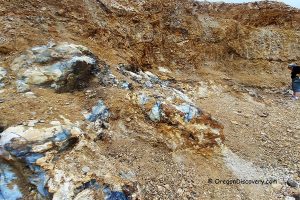
Visitors can explore blue-green clay hills, colorful rock formations, deep volcanic canyons, the John Day River, and the popular Blue Basin area.
Clarno
The Clarno Unit is the smallest and most remote section of the monument. It also preserves some of the park's oldest fossil-bearing formations.
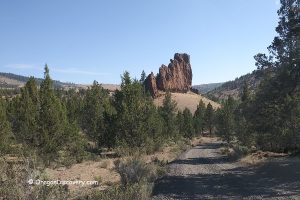
Many important discoveries were made in the Clarno Palisades — heavily eroded volcanic cliffs stretching for nearly a mile along the highway.

John Day Fossil Beds: Camping & Lodging
Camping is not allowed within the John Day Fossil Beds National Monument itself. However, several campgrounds are located nearby, including Bingham Springs Campground, Burnt Ranch Campground, and Antelope RV Park.
For visitors exploring the Painted Hills or Sheep Rock units, Mitchell is the closest town with services and lodging, located about 11 miles from the monument.
Several historic hotels in Mitchell date back to the late 1800s and still welcome guests today. The Oregon Hotel offers vintage-style rooms with private or shared bathrooms, as well as kitchenette options.
Painted Hills Vacation Rentals provides more modern accommodations, while Mitchell City Park offers camping facilities.
Additional hotels, restaurants, and services can also be found in Prineville, about 50 miles west of the monument.
Affordable Vacation Rentals Near John Day Fossil Beds National Monument
John Day Fossil Beds National Monument | Facts
Open: Year-round
Managed by: National Park Service
Amenities: Vault toilets, picnic tables, visitor center, museum, bookstore
Activities: Hiking, nature viewing, and photography
Distance from the parking: Varies
Road access: Any vehicle
Day-use fees: None
Elevation: Varies
John Day Fossil Beds National Monument is located:
- 11 miles northwest of Mitchell
- 198 miles southeast of Salem
- 199 miles southeast of Portland.
Adventures Nearby





Directions to John Day Fossil Beds National Monument
From Mitchell to Painted Hills,
-
- Take US-26 West for 3.6 miles
- Turn right onto Bridge Creek Road/Burnt Ranch Road and follow it for 5.6 miles
- Turn left onto Bear Creek Road and follow it for 1.1 miles
- Turn left onto Painted Hills Viewpoint.
There are multiple parking lots available, including a separate lot for each trail.
From Dayville to Sheep Rock Visitors Center,
- Take US-26 W/Franklin Street for 6.9 miles
- Turn right onto OR-19 N and follow it for 2 miles
- Turn left towards the visitors' center.
There are multiple parking lots at Sheep Rock. Consult the visitors center and follow the signs.
From Fossil to Clarno,
- Take OR-218 W for 16 miles
- Parking lot will be on your right.
You May Also Like