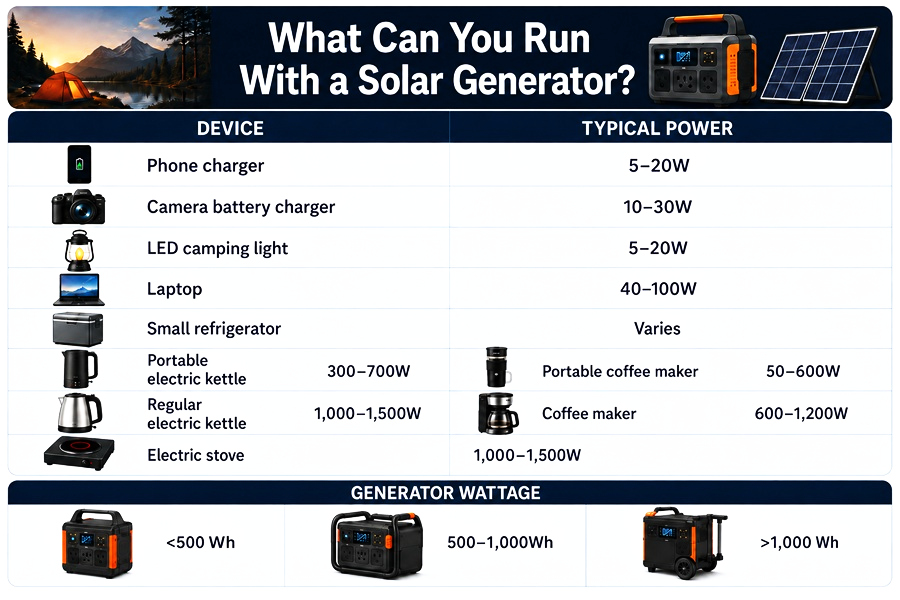
Losing power at home is annoying. Losing power while camping can be even worse.

Your phone dies. Your camera dies. And those little string lights? Dead too. That's when you realize something simple: power matters, even when you're trying to unplug.

A portable power station can keep your essential electronics running without gasoline, fumes, or a noisy generator. Let me walk you through how to pick one.


What Is a Solar Generator?

A "solar generator" is usually a portable power station paired with one or more solar panels.

That's it. No engine. No gasoline. No exhaust.

Most shoppers search for "solar generator," so that's the term you'll see everywhere online. But when you buy one, you're usually buying the portable power station first. The solar panel is often sold separately.

Visit our Amazon Store to explore gear selected for camping and outdoor adventures

Why Use a Solar Generator for Camping?

Here's what a portable power station can do for you:

  • Keeps phones, cameras, headlamps, and lights charged
  • Powers small appliances like a fan, a CPAP machine, or a coffee maker
  • Recharges from the sun
  • Provide power for longer trips and remote spots where there's nothing for miles.

And here's a bonus most folks don't think about. A portable power station can also provide backup power during a home power outage. More powerful models can keep a small refrigerator running, power a microwave, or run portable cooking appliances, depending on the appliances' power requirements.

Pretty handy for one box, right?

Portable Solar Power Station Buying Guide

How Much Power Do You Need?

This is the part people get wrong. So let's slow down here.

There are two numbers on every power station. You need to understand both.

Wh (watt-hours) tells you how much energy the battery stores. Think of it like the size of your gas tank.

W (watts) tells you how much power the station can deliver at one time. Think of it like the size of the engine: a bigger number means it can handle more demanding appliances.

A big battery with a low-wattage inverter may have plenty of stored energy but still won't run a high-powered appliance. Both numbers matter.

A big tank with a skinny fuel line won't run a hungry appliance. Both numbers matter.


How Much Power Station Capacity Do You Need?

This is the part people get wrong. So let's slow down here.

If you're doing short weekend trips and need to charge phones, cameras, tablets, and LED lights, a station in the 300–500 Wh range is often enough.

That's what I'd recommend to friends who are new to this. It's relatively light, easy to carry, and can handle basic charging needs.

GRECELL 500W Portable Power Station with 100W Solar Panel - Best for basic camping, and the best kit with a solar panel included
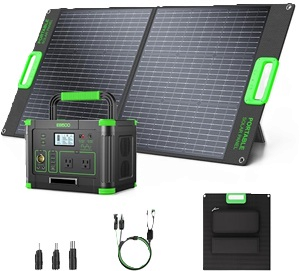
  • 519.48Wh Capacity: 500W rated output with 1,000W peak, plenty for phones, laptops, cameras, and lights
  • 10 Ports: Two pure sine wave AC outlets, three USB-A QC3.0, one 60W USB-C PD, a DC car outlet, two DC 5.5/2.5 ports, and a wireless charging pad on top
  • 100W Panel Included: Monocrystalline cells with up to 23.5% conversion efficiency, plus a smart chip that guards against overcharging
  • Smart BMS Built In: Temperature control, overvoltage, overcurrent, and short-circuit protection
  • Compact Size: 11.5 x 7.9 x 7.9 inches, so it sits on a camp table without taking it over
  • Adapters in the Box: Multiple DC connectors and a storage bag, so the panel works with most other power stations too

 

Price

Step up to the 700–1,000 Wh range and things open up.

Now you can run more electronics, a small 12V refrigerator, more demanding outdoor gear, and even some cooking appliances, depending on their wattage.

A 700–1,000Wh station can carry you through several days of basic charging without much worry.

Jackery Solar Generator 1000 v2 with 200W Solar Panel - Best for longer trips, and the best compact option too
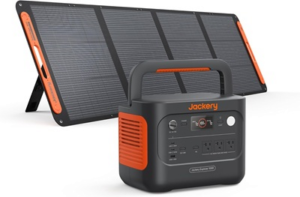
  • 1,070Wh Capacity, 1,500W AC Output: 3,000W surge peak, enough for a fridge, an electric pot, or a small AC unit
  • Only 23.8 lbs: Lightest unit here for the power you get, with a foldable handle
  • 1-Hour Fast Charge: Turn on emergency charging in the Jackery app for 0 to 100% in an hour, or leave it in the default 1.7-hour mode to protect the battery
  • 4,000 Cycle LFP Battery: Still holds over 70% capacity after 4,000 charges, which is a 10-year-plus lifespan
  • 200W Panel Included: Reaches 80% charge in about 6 hours of decent sun
  • Good Port Mix: Two USB-C (100W PD), one USB-A, one DC car port, three pure sine wave AC outlets, plus built-in LED lights
  • Quiet Mode: A 30 dB overnight charging setting, which is a real thing if you're charging near the tent


Price

Go 1,000–2,000 Wh or more, and you have much more flexibility for off-grid use.

Depending on the station's output, you may be able to run a refrigerator or freezer, electric cooking appliances, and several smaller devices at once.

This is what I'd take on longer trips when I want to run an electric kettle and similar appliances.

Here's the trap: a large Wh capacity doesn't automatically mean the unit can run a powerful appliance. It's easy to buy a 2,000Wh station with a weak inverter and then wonder why it can't run a high-powered cooktop.

Also check the surge or peak watt rating. Some appliances, especially refrigerators and other motor-driven devices, can briefly draw more power when they start.

Anker SOLIX C1000 Portable Power Station - Best for cooking and high-power appliances
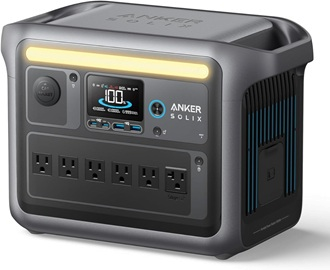
  • Serious Output: 1,800W continuous with 2,400W peak through SurgePad, so it handles heat-producing appliances most 1kWh units choke on
  • 1,056Wh LiFePO4 Battery: Rated for 3,000 cycles and a 10-year lifespan, so you're not replacing it in three summers
  • 58-Minute Full Charge: UltraFast AC recharging hits 80% in about 43 minutes when you turn it on in the Anker app
  • 11 Ports: AC outlets, USB-C, USB-A, and a 120W car outlet, so the whole family can plug in at once
  • 600W Solar Input: Fully recharges from panels in roughly 1.8 hours in good sun
  • Doubles as Home Backup: Under 20ms UPS switchover keeps a fridge or router alive when the grid drops
  • Weight: 27.6 lbs, and it's about 15% smaller than most 1kWh units, which matters in a packed trunk


Price

Keep in mind: actual consumption varies by model and by how long the appliance runs. A fridge doesn't pull power nonstop. It cycles on and off. But a kettle pulls hard the whole time it's on.

Here's a rough formula to use in the field. Take the capacity in Wh, multiply it by 0.9, then divide by the device's wattage. That gives you a rough runtime in hours.

The 0.9 is a simple allowance for energy lost during conversion.

So a 1,056 Wh station running a 100W fan? Roughly 9–9.5 hours. Close enough for planning.


Don't Forget the Solar Panel

Buying a big battery and forgetting the panel is the most common mistake to make. Don't do it.

A few quick things to know:

  • Panel wattage: affects how fast your battery can recharge. More watts generally means faster charging in good sun.
  • Real-world conditions: clouds, shade, season, and panel angle can all reduce your output. A 100W panel rarely produces a true 100W in real-world conditions.
  • Solar input: Check your power station's maximum solar input before you buy a panel. If your station accepts up to 600W of solar input, a single 100W panel will work, but charging will be much slower than with a higher-wattage setup.

FlexSolar 100W Foldable Portable Solar Panel - Best add-on panel if your power station came without one
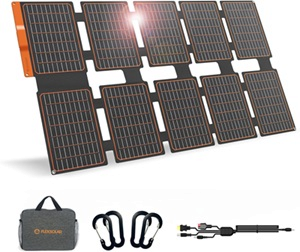
  • 4.1 lbs Only: Folds to about 13 x 10 x 2 inches with a carry bag, and opens to 45.47 x 26.18 inches
  • 23%+ Efficiency: Monocrystalline cells with E-Film lamination, so it still pulls something on overcast Oregon days
  • 4-in-1 Cable Included: DC5521, DC7909, Anderson, and XT60 connectors, which covers most power stations on the market
  • Charges Devices Directly: 45W USB-C PD 3.0 and 18W USB-A ports, so you can skip the battery entirely for a phone top-up
  • IP67 Waterproof and Dustproof: Handles rain, sand, and dust without babysitting
  • Slim Profile: 0.59 inches thick, so it slides behind a seat or under a cot

 

Price

Features to Look for in a Portable Power Station

Once you've settled on size, look at these:

  • Ports: How many, and what kinds? Count your devices first.
  • AC output: Check the continuous watt rating. Also check the surge or peak rating for appliances that need extra power when starting.
  • USB-C: 60W or 100W Power Delivery can let you charge many laptops directly without their AC adapter.
  • Weight: 24 lbs. versus 42 lbs. feels very different.
  • Handle and portability: A folding handle can make the power station easier to store and carry.
  • Battery chemistry: Go with LiFePO4 if you can. Many LiFePO4 power stations are rated for 3,000 or more charge cycles, generally much more than older lithium-ion batteries.
  • Display: Watts in, watts out, battery level, and time remaining can save you from guessing.
  • Pass-through charging: Lets the station charge while it powers your gear.
  • Expandable battery: Consider this only if you think you'll need more capacity later.

Looking for more choices?

Visit our Amazon Store to explore gear selected for camping and outdoor adventures

My Bottom Line

Start with what you actually plan to plug in. Write it down. Add up the watts. Then buy a station with enough Wh for your trip length and enough continuous AC watts for your hungriest appliance.
Skip that step, and you could end up in the desert with a dead phone and a nice view you can't photograph.


You May Also Like