
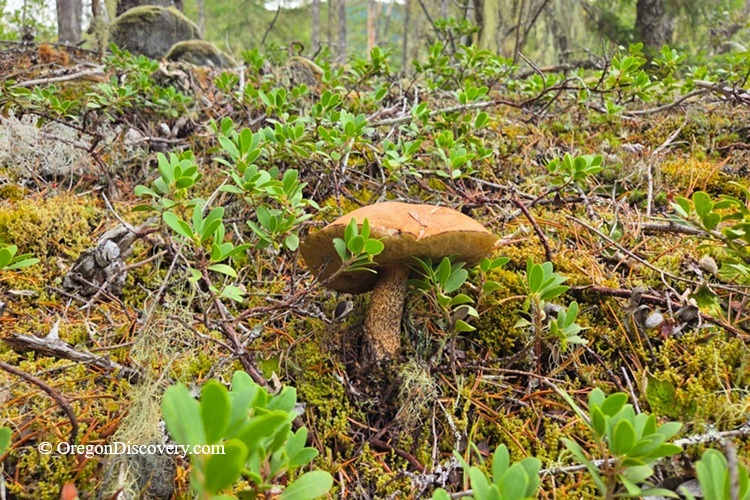
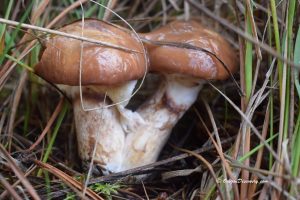
The Aspen Bolete (Leccinum insigne) is a woodland mushroom with a reddish-brown cap and a pale stem covered with dark scales. It is also called the Aspen Scaber-Stalk or Aspen Rough-Stem. It usually grows near aspen trees, which can help identify it.
Some field guides describe this mushroom as edible, but caution is needed. Similar-looking Leccinum mushrooms have caused poisonings in the Pacific Northwest and Rocky Mountains.
Leccinum insigne, including mushrooms that were cooked. Cooking does not guarantee that these mushrooms are safe to eat.
Where to Look for Aspen Boletes in Oregon
For Aspen Boletes, start by learning the trees. Leccinum insigne is associated with aspen, and identifying the surrounding trees is essential to identifying mushrooms in this group. A reddish cap alone is not enough.
In Oregon, aspen trees grow in several mountain areas. According to the Forest Service, aspen groves grow in the Blue Mountains, on Steens Mountain, and in the Trout Creek Mountains.
These areas may be worth exploring, but the presence of aspens does not guarantee that Aspen Boletes grow there.
Aspens often grow along the edges of moist meadows, on mountain slopes, and near streams. Since Aspen Boletes grow with aspen trees, these areas are a better place to start than conifer forests without aspens.
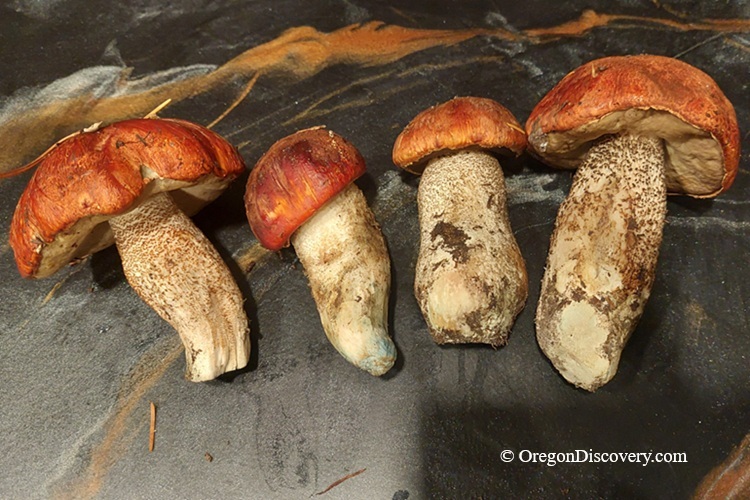
Cap: Bun-shaped when young, becoming broadly convex to nearly flat with age. Surface dry, sometimes finely fibrous, with cap skin that may overhang the pore layer. Reddish-brown, rusty brown, or orange-brown; typically 1.5–6 inches (4–15 cm) wide.
Cap's Underside: Sponge-like, with small, rounded pores. Whitish when young, becoming yellowish to olive-brown with age; bruised areas may turn brownish.
Spores & Print: Spores elongated, somewhat spindle-shaped to nearly cylindrical. Spore print brown to dark yellow-brown or olive-brown.
Steam: Tall and nearly cylindrical, sometimes enlarged toward the base; typically 3–5 inches (8–13 cm) long. Whitish, covered with small, rough scales called scabers, which darken to brown or black.
Flesh: Firm and white, becoming gray to purplish-gray and eventually blackish when cut or bruised. Some specimens may show blue staining near the stem base.
Fruiting: Scattered or in small groups on the ground.
Habitat: Mycorrhizal primarily with aspen trees.
Season: From spring through fall, depending on location and conditions.
Aspen Bolete Look-Alikes
Birch Bolete (Leccinum scabrum)
Birch Boletes also have pale stems covered with dark scales. However, their caps are usually tan, gray-brown, or dark brown rather than reddish-orange. They grow with birch trees, and their flesh usually changes little after cutting, although some browning may occur. In the Pacific Northwest, they are sometimes found near planted birch trees.
Other Red- and Orange-Capped Leccinum
Several related mushrooms have reddish caps, rough stems, and flesh that darkens after cutting. Some grow near conifers rather than aspens.
Are Aspen Boletes Edible?
Some field guides describe Aspen Boletes as edible. However, these mushrooms have been linked to cases of poisoning, so they should not be considered safe to eat.
The North American Mycological Association (NAMA) has recorded cases of nausea, vomiting, diarrhea, and stomach cramps linked to Leccinum insigne. Some cases involved raw mushrooms, while others involved cooked mushrooms.
Cooking does not guarantee safety, and identifying a mushroom by its appearance alone is not enough to know whether it is safe to eat.
Beginners should enjoy finding and photographing Aspen Boletes and learn to identify them with an experienced local mushroom expert before considering them for food.
You May Also Like



Disclaimer
This is not an official guide to wild mushroom foraging. Please do your own research and learn from an experienced mushroom expert before collecting or consuming any wild mushrooms.
Before you begin foraging, learn to accurately identify both edible and toxic mushrooms. Never consume a wild mushroom unless you are certain of its identification and edibility. Follow proper preparation and cooking instructions for each species, as some edible mushrooms must be thoroughly cooked before consumption. Be aware that even correctly identified edible mushrooms can cause adverse reactions in some people.