A dead phone on the trail is a real problem. It's more than an annoyance.

Your phone might be your map, your camera, and your way to call for help. That's why a portable charger for hiking belongs in your pack, right next to your water and your headlamp.

This guide covers small, lightweight charging gear you can carry in a backpack. Big solar panels for portable power stations aren't part of it.

For that setup, see our guide: How to Choose a Portable Solar Power Station for Camping

Why Reliable Power Matters on the Trail

Think about how much you use your phone on a hike. Most of us use it all day. On a typical trip, it helps you:

  • Navigate: Follow trail maps and check where you are with GPS apps.
  • Communicate: Text your buddy at the trailhead or check in with family.
  • Take photos: Get that shot of Proxy Falls or the view from a ridge.
  • Handle emergencies: Call 911, share your location, or check the weather.

On top of that, phones aren't the only things that need power. A lot of hikers also carry:

  • GPS units and satellite messengers (like the Garmin GPSMAP 66i)
  • Rechargeable headlamps
  • Smartwatches
  • Wireless earbuds and small cameras

Here's the thing. A GPS app running all day can drain a phone battery fast. Cold weather drains it even faster. So if your phone dies halfway through the day, what's your backup plan?

Two Main Options: Store Power or Make Power

You've got two main choices for keeping your gear charged:

  1. Power banks store electricity. You charge them at home and then use that power on the trail.
  2. Solar chargers make electricity from sunlight. You unfold them in the sun and charge your devices or a power bank.

Which one is right for you? That depends on four things:

  • How long your trip is
  • How much you use your devices
  • How much sun you'll get
  • How much weight you're willing to carry


Power Banks vs. Solar Chargers: What Is the Difference?

Power Banks Solar Chargers
What it is A portable battery. You fill it up at home, toss it in your pack, and plug in your phone when it gets low. A folding panel that turns sunlight into power. Many hikers strap one to the top or back of their pack while they walk.
Pros
  • Works anytime: Rain, shade, or nighttime makes no difference.
  • Simple to use: Plug it in and you're done.
  • Predictable: You know how much power you're starting with.
  • Unlimited power (in theory): As long as the sun shines, it keeps working.
  • Great for long trips: You can refill a power bank without an outlet.
Cons
  • Runs out: When it's empty, it stays empty until you recharge it.
  • Weight grows with capacity: More power means a heavier battery.
  • Needs direct sun: Clouds, shade, and tall trees slow it way down.
  • Slower than you'd think: A panel almost never puts out its full rated power out in the field.
  • Takes time: You need hours of good sun to see real results.


What About "Solar Power Banks"?

You've probably seen power banks with a small solar panel built right in. These are handy, but don't count on that tiny panel for real charging.

For example, the built-in panel on the MINRISE power bank peaks at about 1.8 watts. At that rate, filling a big battery from sunlight alone could take days of strong sun. So treat the built-in panel as an emergency backup only. Charge these power banks at home before every trip.

How to Choose a Portable Charger for Hiking

You don't need the most expensive gear. However, a few features make a big difference.

1. The Right Capacity

Power bank capacity is measured in mAh (milliamp-hours). A bigger number means more stored power.

  • 10,000mAh: About 2 phone charges. Good for day hikes.
  • 20,000mAh: About 3–4 phone charges. A sweet spot for weekend trips.
  • 40,000mAh and up: Lots of power, but heavier. Better for groups or longer trips.

Tip: You won't get the full rated amount. Some power gets lost as heat while charging. So plan for a little less than the box says.

2. Weight

Every ounce counts on a long climb. A 20,000mAh bank is a good balance for most hikers. Before you buy, check the weight on the listing.

3. Fast Charging

Look for USB-C with PD (Power Delivery) fast charging. It refills your phone quicker. In addition, it recharges the power bank faster at home.

4. Built-In Cables

Built-in cables mean one less thing to forget. That's a real win when you're packing at 5 a.m.

5. Weather Resistance

Oregon trails get wet. Look for a water-resistant rating like IPX5. Still, no power bank should go for a swim, so keep it in a zip bag when it rains.

6. For Solar Panels: Watts and Ports

For a solar panel you carry on your pack, around 20–30 watts is a good range. Look for multiple USB ports and a folded size that fits your pack.

Important: Don't plug your phone straight into a solar panel on a cloudy day. When a cloud passes, the charging can stop and start over and over. A better plan is to charge a power bank with the panel and then charge your phone from the power bank.

Two Power Banks and One Solar Charger to Chose From

Want a pocket-friendly power bank for weekend trips? Check out the BLAVOR 20000mAh

Need more power for longer trips or a group? Take a look at the MINRISE 40000mAh

Planning a multi-day trek in sunny country? Pair a power bank with the BigBlue 28W solar charger

BLAVOR Solar Power Bank 20000mAh: Best Overall for Hikers
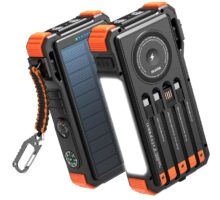
If I could only pick one, this would be it. It's light, it charges fast, and it has the features that matter on the trail.

  • 20,000mAh battery with 20W USB-C fast charging
  • 4 built-in cables, plus a wireless charging pad for phones and Apple Watch
  • IPX5 water-resistant, with a camping flashlight and a carabiner

Say you're doing an overnight trip to a lake in the Cascades. This bank can recharge your phone a few times, top off your headlamp, and keep your watch going.

Note: The solar panel on top is a slow trickle charger, so charge it at home first.

 

Price

If you make a purchase via our links, Oregon Discovery earns a commission at no additional cost to you

MINRISE Solar Power Bank 40000mAh: Best High-Capacity Pick
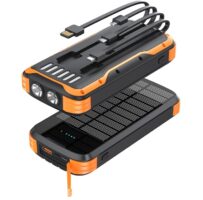
Do you need more juice? This one gives you double the capacity of a 20,000mAh bank, and it weighs about 1.35 lbs. That makes it a solid choice for longer trips, base camps, or sharing power with a friend.

  • 40,000mAh battery with 20W PD fast charging
  • Built-in cables (USB-C, iOS, Micro USB, and a USB-A input)
  • Dual bright flashlights, plus a rugged, drop-resistant build

Flying to your trailhead? A 40,000mAh bank is usually over 100 watt-hours, and many airlines limit those. Check your airline's rules before you pack it.


Price

If you make a purchase via our links, Oregon Discovery earns a commission at no additional cost to you

BigBlue 28W Solar Charger: Best Solar Panel for Backpacking
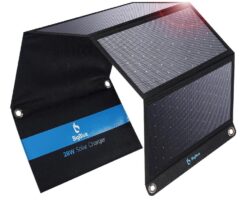
This is the panel to get if you want real solar power on a long trip. It has close to 10,000 reviews, and long-distance hikers have tested it for years.

  • 28W panel with high-efficiency cells (rated up to 25.4%)
  • 3 USB ports (2 USB-C and 1 USB-A)
  • Weighs about 1.25–1.5 lbs and folds to about 11 x 6 inches

Strap it to the top of your pack on a sunny trip through Central or Eastern Oregon. Then let it refill your power bank while you walk. As a result, you can stay out longer without hunting for an outlet.

Note: The panels resist splashes, but the USB port box isn't waterproof. Tuck it away when rain rolls in.


Price

If you make a purchase via our links, Oregon Discovery earns a commission at no additional cost to you

Simple Tips to Save Battery on the Trail

Good gear helps. On the other hand, smart habits help just as much.

  • Download offline maps before you leave the trailhead.
  • Turn on airplane mode when you don't need a signal. Your phone burns battery searching for one.
  • Lower your screen brightness.
  • Keep batteries warm. On cold nights, put your phone and power bank in your sleeping bag.
  • Charge everything the night before. That means your power bank, phone, headlamp, and GPS.

FAQ

How big of a power bank do I need for backpacking?
For most weekend trips, a 20,000mAh power bank is a good starting point. It can charge a typical phone about 3–4 times.

Can a solar power bank charge itself on the trail?
Only a little. The built-in panels are small and slow, so use them as an emergency backup. Always charge the bank at home first.

Is a solar panel worth it for day hikes?
Usually not. A power bank charged at home is lighter, simpler, and more reliable for a day on the trail.

Can I charge my phone directly from a solar panel?
You can. However, it works best to charge a power bank with the panel and then charge your phone from the bank. That way, passing clouds won't keep stopping your phone's charging.

Do solar panels work in cloudy Oregon weather?
They work, but much slower. Shade, clouds, and tall trees cut their output a lot. They do much better in sunny areas like Central and Eastern Oregon.


Final Notes

For most hikers, a power bank should come first. Many day hikers and weekend backpackers can cover all their needs with one good power bank charged at home. It's simple, it works in any weather, and you don't have to think about it.

Solar panels make more sense for longer trips. They're most useful when you have plenty of sunlight and enough time to recharge your batteries. In that case, a light panel like the BigBlue 28W paired with a power bank can keep you going for days.

So charge up before you leave and download your maps. And don't forget your headlamp!


You May Also Like